
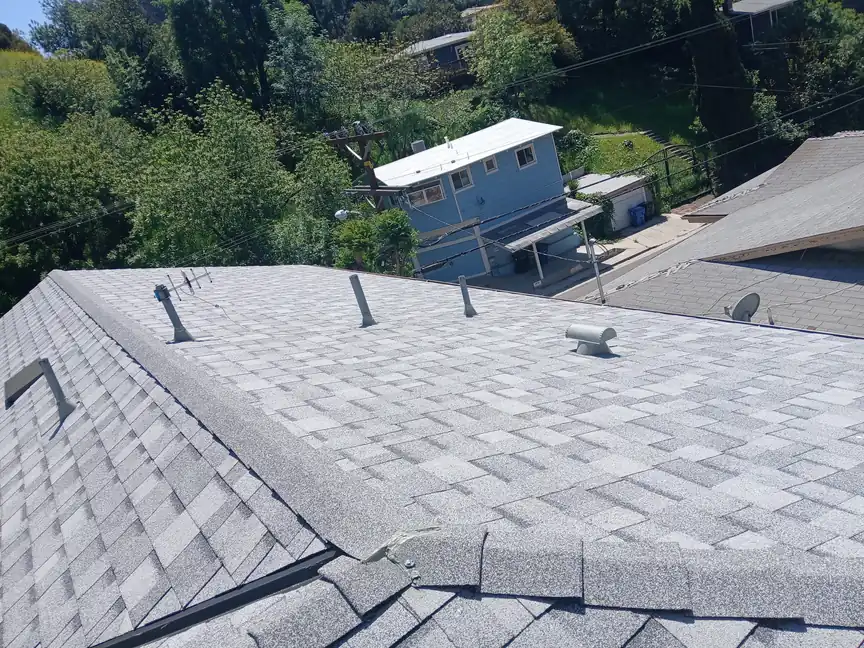
Either you are planning a new roof and already have drawings, or your existing roof has started leaking. The work that follows is not the same, so we ask different questions at the beginning.
Both routes begin with the same conversation. You call, we ask about the property and the roof, and we price the work at no charge. A detailed written report for escrow or an insurance company is a separate paid service.
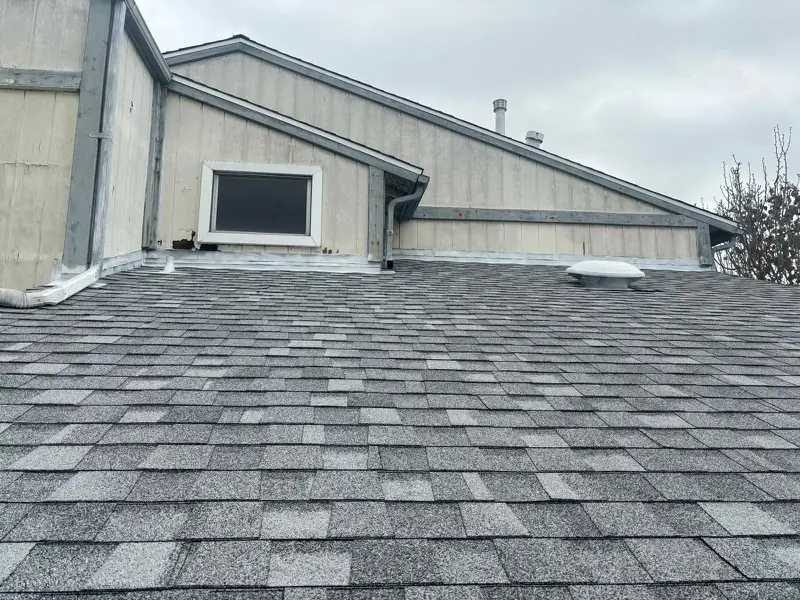
New roof plans or an existing roof concern
If you are building or adding on, we quote directly from the plans you already have. Send the roof drawings and the covering the plans specify, and we price from those documents. General contractors submit plans the same way when they need a roofing number for a client.
Installing a roof on a new structure is not the same job as replacing an existing covering. A new deck has no tear-off, no hidden rot, and no old layers to work around. The estimate reflects that difference, and so does the sequence of the work.
An existing roof problem often shows up in a fairly small way. A ceiling stain after rain, a slipped tile, or a shingle in the yard all qualify. Those signals tell us where to begin looking, but they cannot measure how far the damage actually runs.
Water can travel along the deck and appear in a room far from where it originally entered. So we trace a leak backward toward its entry point instead of patching the visible stain below.
Plans and problems pull an estimate in two different directions. With plans, the roof is a known quantity on paper, and the remaining questions concern material and detail. With an existing roof, the unknown sits under the covering until we actually open it.
What we recommend depends on the roof in front of us, not on a fixed script. We are a Santa Clarita roofing company, and La Cañada Flintridge sits inside the area we cover. So we start with the address, then the roof details that decide the job.
On a residential roof we strip the old covering, check the deck for rot, then rebuild in layers. Commercial and multi-unit buildings follow the same order on a flatter roof with different materials.
The caller is not always the property owner. General contractors call with plans, property managers call about a commercial building, and buyers call during escrow. We ask for the property address first, because every other answer depends on it.
Sometimes the question is not about repair or replacement at all. A buyer in escrow may need the roof condition documented, and an insurer may request the same before renewal.
That written roof inspection is a paid service, and the fee moves with the size of the roof. A free estimate prices the work, while the written report documents the roof's current condition for another party.
Installation details and project coordination
An installation is a delivery problem before it is a roofing problem. Material has to reach the roof, and the old covering has to leave the property. So we ask where a truck can park and where we can stage material.
Access details matter more than most people expect. A shared driveway, a locked gate, or a narrow street changes how we set up on the first morning. Tell us early and we plan around it instead of discovering it on the morning itself.
The roof itself raises another set of questions. How many stories, how steep the pitch, and how many coverings are already installed up there? A second layer left in place changes how much material comes off before new work starts.
Then come the details that usually leak first. Chimneys, wall transitions, valleys, and vents all need flashing, which is the metal that seals those joints. We price that metal work with the roof rather than treating it as a later extra.
Tear-off creates more mess than the finished roof suggests. Old covering, nails, and paper come off first and go straight into a disposal container. On a tile job we stack the tile nearby, so we need a clear staging spot for it.
A low-slope section still has to drain properly. We verify the fall toward the drains and scuppers before choosing a cap sheet. Standing water is a problem to solve, never a normal feature of a flat roof.
Our usual low-slope choice is Polyfresko G, a granulated cap sheet that goes down with heat rather than nails. Modified bitumen is the torch-down system we install on flat and low-slope sections.
People live and work under the roof while we are on it. Pets, parked cars, and anyone taking calls at home all belong in the conversation beforehand. We cannot make a tear-off quiet, but we can explain what the workdays will involve.
We do not name a start date before the scope and the material are settled. Roofing is our part of a build, and the other trades stay with your contractor.
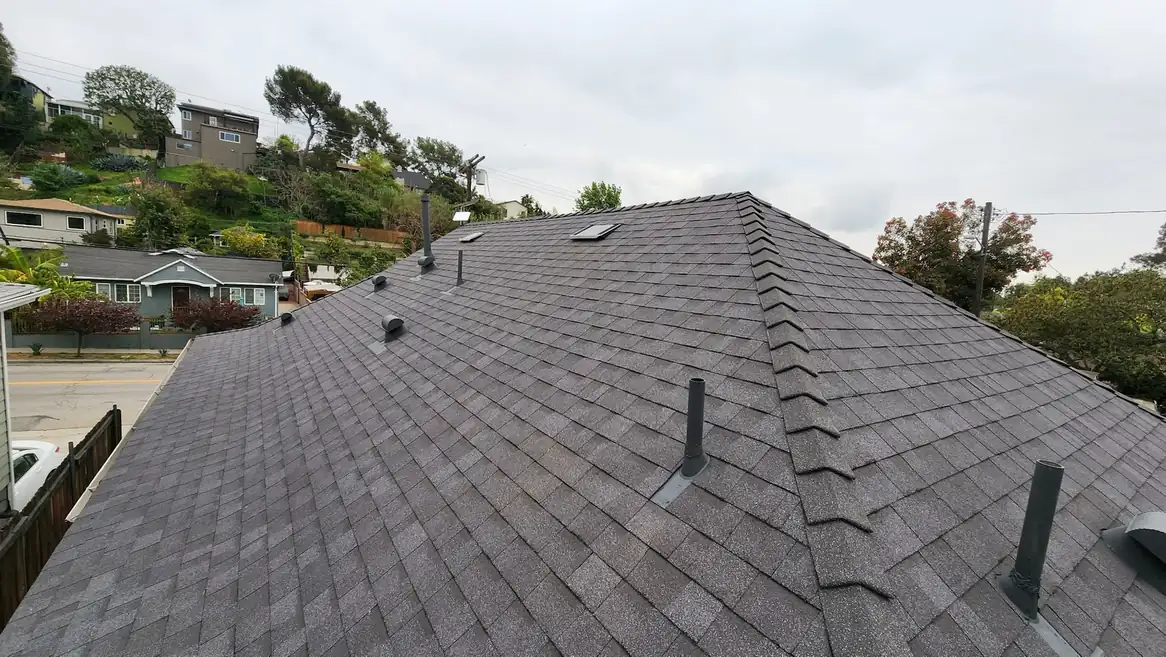
Deciding between a repair and a replacement
The choice between a repair and a replacement comes from the roof's condition. We look at what the covering has left and where water is actually getting in. We repair a contained problem, and we replace a covering that has reached the end of its life.
A roof repair has a clear edge around the problem. Open flashing, slipped tile, a worn valley, or a patch of shingles all fit that description. We take small jobs, and we say so plainly when a repair is only buying time.
Age alone does not decide it. A young covering can leak badly at one bad detail, and an older roof can still hold. We would rather open a small area and know than guess from the ground.
A full roof replacement strips the roof to the deck and rebuilds it. At that point we can see the sheathing, the board layer under the covering, and replace what has rotted. It is also the only work that carries our ten-year workmanship warranty.
Tile sits in its own category. Underneath it sits the underlayment, the waterproof layer that does the actual sealing. That layer can fail while the tile above it is still sound.
Whether the tile can go back down depends on its condition, not on the age of the roof. We call that work a lift and relay, and it keeps the original tile on the house.
We take the tile off in sections and strip the failed underlayment. Then we replace any rotted deck and restack the tile that is still good.
Breakage is part of the job, so every estimate we write carries a tile allowance. We name that allowance before the work starts rather than after a stack of tile cracks.
On commercial buildings the call is often about a repair rather than a full replacement. Seams, drains, and flashing are the details we check first on a flat or low-slope roof.
An active leak moves faster than a planned project. We offer same-day or next-day dispatch when water is entering the building.
Getting someone out to the property is not the same as finishing the repair. Some leaks need dry weather, a material order, or a second visit. We say that clearly up front rather than promise a same-day fix we cannot control.
Roofing in La Cañada Flintridge
La Cañada Flintridge is one of the cities in the areas we serve. We start from the property address, because the address decides which rules apply to the work. It is the first question we ask on the phone.
Roofing permits come from the city a property sits in, not from a neighboring one. For a La Cañada Flintridge address, that is the city's building safety office. We help owners pull the permit a job requires, and we do not guess at approval or timing.
We confirm which office has jurisdiction over your address before anything gets filed. That check keeps the paperwork with the correct office from the very start. Rules also change over time, so we work from whatever the city publishes now.
Fire hazard mapping is done by location, not by city name. If an official map covers your particular address, the roof requirements can be different. We verify the mapped status for the property instead of applying one answer to every street.
Rain here arrives in a narrow winter window after a long dry stretch. A slow leak can sit unnoticed for months and then appear with the first heavy rain. That is why a small stain is worth investigating before the rain season arrives.
The roofing systems we work on do not change by city. We install and replace asphalt shingle, clay and concrete tile, standing seam metal, and torch-down low-slope roofs. Which one belongs on your building depends on the structure and on whatever is already up there.
We work under CSLB #1112525 on every job, residential or commercial. You can look that license number up on the CSLB's public lookup before you call.
The work at a La Cañada Flintridge address is the same work we do anywhere on our map. What changes is the roof itself, the access, and the local paperwork.
Getting your plans and roof details together
A short list of specific details turns a vague call into an actual number. For a new build, the roof plan, the pitch, and the specified covering do most of that work. For an existing roof, the address, the story count, and what you are seeing get us moving.
Plans answer questions we would otherwise have to ask twice. Square footage, pitch, and the roof layout are already drawn, so the estimate can follow them directly. If your architect specified a product, tell us the name, because it changes material and labor.
On a new build we work from the set your contractor already holds. The roof plan and the covering schedule are the two sheets we ask for first. If the design changes after we quote, send the revision, because the price follows the drawing.
We can also measure a roof from satellite imagery while you are on the phone. That gives you a real number early in the conversation. We still confirm the measurement on site before any work begins.
For a roof that is already leaking, the useful details are small and specific. Tell us where the stain is, when it appeared, and whether it follows the rain. If anyone has patched it before, say so, because a patch tells us where to look.
Old invoices or a home inspection report help as well. They tell us the covering, its age, and what a previous roofer already found. If we need a photo of one area later, we will tell you exactly what to send.
Timing does not disqualify a call. If the build is months out, we still want to hear about it. We start the conversation early rather than rush a number at the end.
We can give a number on the call, and the written estimate follows with the detail. It names the system, the tear-off, the tile or wood allowance, and the metal work. Nothing in it should be a surprise once the work starts.
Once you accept the estimate, we confirm the material and the scope before anyone climbs a ladder. A roof opened before the material is on site is a roof left open to weather.
Here is what to have on hand before you call.
- Give us the property address, plus a unit number if there is one.
- Tell us how many stories the building has.
- Name the covering that is up there now, if you know it.
- Say where the water shows inside and when it started.
- Send the roof plan and the specified covering for a new build.
Common questions before a roofing estimate
What affects the scope of roof work?+
Size comes first, measured in squares, which is roofer shorthand for one hundred square feet of roof. Story count, pitch, existing layers, and rot in the deck move the number from there. Tile costs more labor because it comes off and goes back on by hand, one section at a time.
Can I request a written roof report?+
Yes, and it is a separate paid service from the free estimate. The fee moves with the size and height of the roof, so we quote it when you call. Buyers in escrow and insurers asking for a condition report are the common reasons people want one.
What information helps with a roofing estimate?+
Start with the property address, the number of stories, and the covering that is up there now. If the roof is leaking, tell us where the water shows inside and when it started. For a new build, the roof plan and the specified covering are enough for us to price from.
Send the plans if you have them, or tell us where the leak shows if you do not. Either way the estimate is free, and the conversation starts with your address.
Call (661) 367-8211 to talk the roof through, or use the contact form if writing it out is easier. We will ask a few questions, give you a number, and tell you what the next step looks like.
Santa Clarita Roofing Contractors is a division of Home Vision Remodel.