
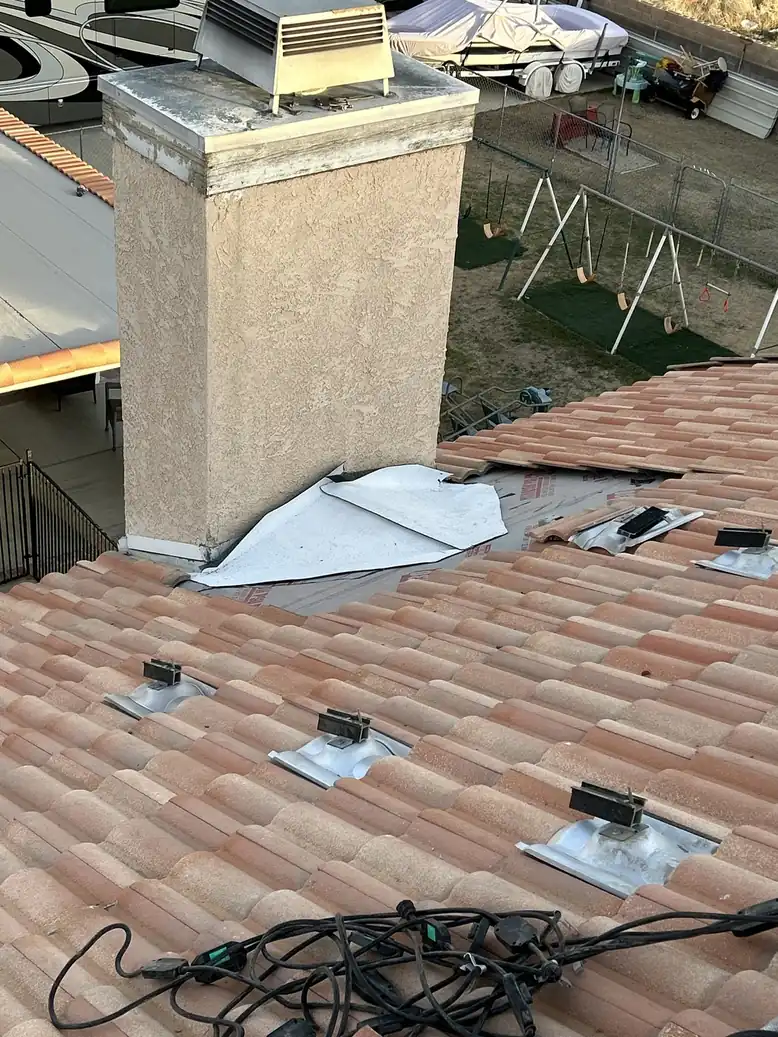
A roof replacement plan starts with the roof you already have, and its age always matters. So do the deck, the flashing, and the waterproof layer that sits under your tile or shingle. We look at those parts first, then talk about the material that belongs back on your roof.
You can get a free estimate from us before you decide anything at all about the project. We price from roof size, pitch, the number of stories, and the material sitting under the covering. If a repair will hold your roof together for now, we will honestly tell you that instead.
Roof replacement starts with existing conditions
Two roofs of the same age can still need very different work from each other. One may need new metal at a wall, while the other has soaked decking across a whole slope. So we start with the actual condition of your roof, not with a standard replacement package.
Flashing is the metal that seals a roof against a wall, a chimney, or an open valley. It is a leading source of leaks, so we always check it before pricing a new roof. When the rest of the covering is still sound, a targeted repair can be the more honest answer.
Water also travels a long way once it gets past the covering on your roof. A stain on your ceiling can sit feet away from the spot where the roof let it in. That is why we trace the entire path instead of patching the nearest visible hole.
Other roofs are already well past the repair stage by the time we arrive. Underlayment, the waterproof layer beneath your tile or shingle, can wear out while the tile still looks fine. When that layer has failed across the whole roof, a patch buys you very little time.
That is the point where we price a full roof replacement instead of another repair. On tile, there is also a middle path, and the condition of your tile decides whether it works. Roofers call that middle option a lift and relay, and it can save the existing tile.
We lift the tile in sections, strip the old underlayment, then repair bad wood and lay new underlayment. Tile that comes through the process in good shape goes straight back onto the same roof. Brittle or cracked tile cannot survive that, so we look at yours closely before promising anything.
Replacement and new installation are also two different jobs with very different starting points. A replacement starts with removing the covering that is already sitting on the building. A new roof on new construction starts instead with plans and bare wood framing.
An estimate visit covers the roof, the joints, and any ceiling inside where you saw water. We also want to know the age of the covering and whether anyone has layered over it. Existing layers matter, because stripping two coverings takes far more labor than stripping a single one.
No page can tell you exactly which job your own roof needs today. Two houses on the same street can get completely different answers, for perfectly good reasons. We use the same careful steps here that we use on Santa Clarita roofing jobs.
Materials and the underlying roof assembly
A roof is a stack of connected parts, not a single product you buy off a shelf. Under the tile or shingle sit the underlayment, the deck, and metal at every edge and joint. A new covering installed over a bad deck will not last very long.
The deck, also called sheathing, is the wood surface the whole roof is nailed to. Nobody can see its real condition while the old covering is still sitting on top. Soft or rotted boards come out and get replaced before any new material goes down.
A replacement then runs in a set order that rarely changes from roof to roof. We strip the covering, repair the deck, dry it in with underlayment, then install the new covering. Edge metal and flashing go in as that stack goes together, rather than afterward.
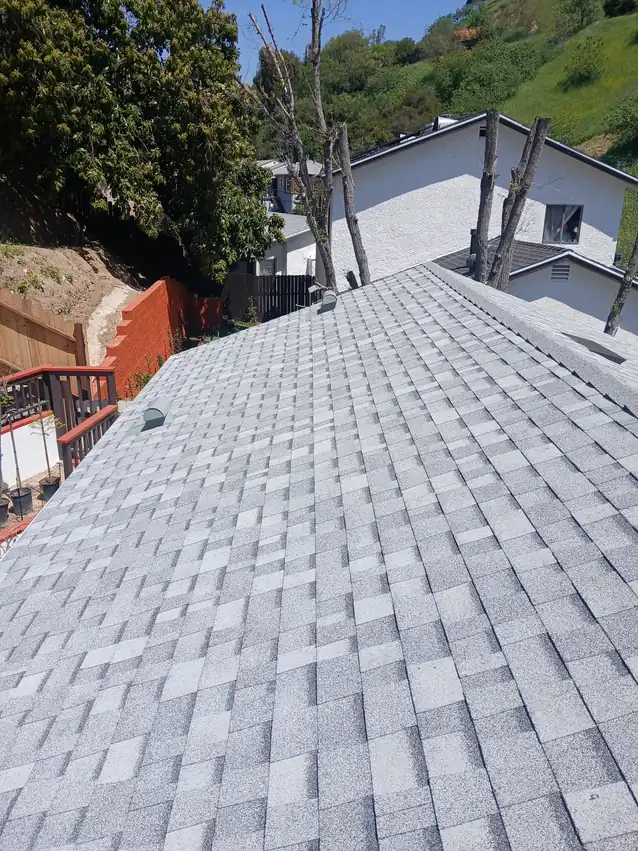
Asphalt shingle work is straightforward once the deck underneath has been repaired and is sound. We strip the old shingle, replace bad wood, then lay new underlayment and new shingle. That sequence is the core of our residential roofing work on a house.
We also work on clay tile, concrete tile, and natural slate roofing. Tile itself can still be serviceable after the underlayment beneath it has already failed. Whether we can reuse yours depends on how it holds up when we lift it.
Slope decides more of the material choice than personal taste or appearance ever does. Shingle and tile shed water down a pitch, so they need enough slope to work properly. A shallow roof needs a welded or sealed membrane instead, because water sits on it longer.
Flat roofs are never truly flat, and they still have to drain water somewhere. Our low-slope system is torch-down modified bitumen, a sheet material welded down with heat. Water standing on a low-slope roof is a problem to solve, not a feature of the design.
The cap sheet we use is Polyglass Polyfresko G, an APP granulated cap sheet applied by heat welding. A cap sheet is the top layer you walk on and the one that takes the sun. On commercial low-slope work, a TPO membrane is available as well.
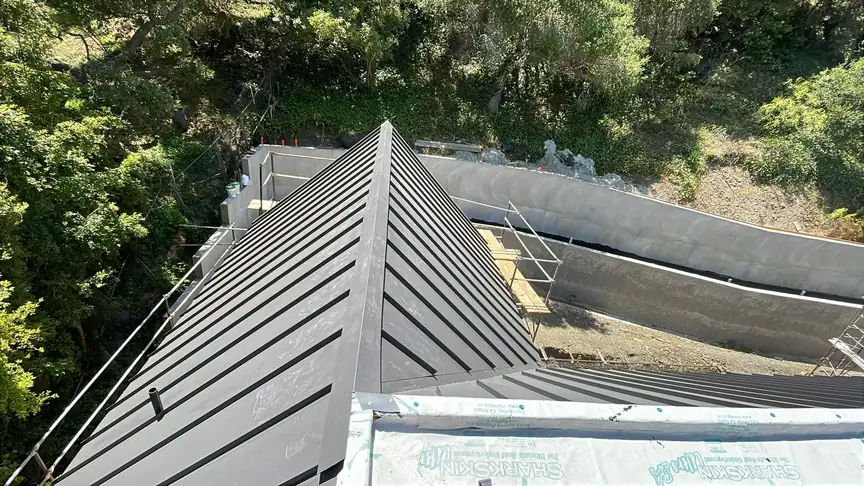
Metal is another route, and standing seam is the version we install on houses. Its panels join at raised seams, and the fasteners stay hidden underneath the metal. Slope, deck condition, and the appearance you want all steer that material choice.
Fire ratings belong to the whole assembly, not to one single product in the stack. A Class A rating comes from a tested build-up of covering, underlayment, and deck. So the individual parts have to work together as one complete tested set.
What may change after tear-off
Tear-off means stripping the old covering completely down to the bare deck. It is also the first honest look at the wood underneath your roof covering. What we find there can change the scope, so we would rather mention it early.
In roofing, rotted decking is easily the most common change order on a project. Nobody can price it from the driveway, because the boards sit hidden under the covering. We show you what we find, and wood repair beyond the included allowance is priced by the square foot.
On tile, some breakage is normal as the tile comes off and goes back on. Our estimates carry an allowance for that expected breakage. If your tile is brittle or no longer manufactured, reusing all of it may not be realistic.
Tear-off is also the right moment to deal with the existing flashing. The metal at a wall or a chimney has taken the same weather as the covering above it. Replacing it along with the roof keeps those weak joints from staying weak.
Old vents and pipe boots come off with the covering as well. Putting tired ones back under a brand new roof is a very short-lived saving. We would rather replace them completely while the deck is still open.
California's wildfire rules can change what material goes back on your roof. Those rules apply if your property sits in a mapped High or Very High Fire Hazard Severity Zone. In that mapped scope, replacing the covering, or half or more within a year, can require a new-construction covering.
Those zones are mapped parcel by parcel, so the answer is specific to your own address. You can confirm where your property stands before anyone chooses the roof assembly. Outside those mapped zones, the state sets a lower minimum class for the covering.
None of this argues against a tear-off on your roof. Going down to the deck is the only way to repair the wood that sits under the covering. An overlay only hides the same damaged wood you were worried about.
A few things regularly show up once the old covering is off:
- soft or rotted decking boards
- old flashing that will not seal against new material
- a second covering layer nobody knew about
- damage around vents, valleys, and wall joints
Simi Valley roofing coverage
Simi Valley is one of the cities our roofing company serves. We take residential house work there, and we take commercial low-slope work as well. The rest of the coverage map sits on our service areas page.
Every estimate call starts with the property address itself. It tells us which authority reviews a permit, and it lets us pull up the roof. From satellite imagery we can measure the roof and discuss real numbers on that first call.
A number from imagery can still move once someone stands on the roof and measures it. Pitch, access, existing layers, and the condition of the wood all pull it one way or another. We would rather explain that now than surprise you later.
Roof permits inside the city limits go through the City of Simi Valley. We help property owners pull the permit a job needs, though the city decides the outcome. You can check the current requirements with the city's building safety department.
Some properties near a city line sit in unincorporated county area instead. The county reviews those permits rather than the city building department. We confirm which authority applies instead of assuming anything from the mailing address.
Commercial low-slope work runs on exactly the same footing as residential house work. We look at the deck, the drains, and the seams before we price the sheet. Property managers can ask for licensing and scope details before they schedule anything.
Southern California packs most of its rain into a short winter stretch. A roof can hide a small failure all summer, then show it in the first heavy storm. Planning before that rain arrives is easier than planning during it.
If you want a real number before you commit to anything, call (661) 367-8211. The estimate is free, and we can start from the address and what you are seeing.
Questions to settle before roof work
A few questions are worth settling before anyone climbs a ladder at your property. These are the ones we hear on the phone, in one form or another.
Ask who holds the contractor license and who will actually do the work on your roof. We work under CSLB #1112525, and you can look that license number up yourself. Santa Clarita Roofing Contractors is a division of Home Vision Remodel.
It is also fair to ask who actually picks up the phone when you call. On our line you reach the people who price roofs for a living. They can answer material and scope questions while you are still on the call.
Warranty terms are worth pinning down carefully before you sign anything. We give a ten-year workmanship warranty on a full roof replacement. Repairs and manufacturer coverage are separate, so ask about each one individually.
It also helps to know which product you are buying, an estimate or a report. A free estimate is simply our price for doing the actual work. A written inspection report is a separate paid service, and the fee follows roof size and stories.
Buyers in escrow and insurers asking for documentation are two reasons people want that paperwork. When you need it, our roof inspection work is where that document comes from. Call for the current fee, since it moves with the size of the roof.
Cost questions deserve a straight answer, even before anyone has measured the roof. Squares, pitch, stories, existing layers, and wood repair are the drivers we price from. A square is a roofer's unit of measure, and it covers a hundred square feet.
The estimate document itself is worth understanding too. We measure from imagery first, then adjust once someone has seen the roof up close. A written scope is worth having in hand before you agree to anything.
If water is coming in right now, please say that at the start of the call. An active leak changes what we look at first on the property. These are fair questions, and the answers cost you nothing but a phone call.
Common questions about roof work in Simi Valley
What affects the scope of roof work?+
Size, pitch, and the number of stories set the basic labor required on any roof. Existing layers, rotted decking, and tile that must come off and go back on can change it further. A mapped fire hazard zone can also set requirements for the assembly that goes back down.
Can I request a written roof report?+
Yes, and it is a paid service that sits entirely apart from the free estimate. Buyers in escrow and insurers who ask for documentation are two reasons people want one. The fee follows roof size and the number of stories, so call for the current figure.
What information helps with a roofing estimate?+
Start with the property address, since it lets us pull up the roof and measure it. Tell us what you are seeing, the covering type if you know it, and the number of stories. We may ask for more detail or come out to look before the number is final.
The next step is a conversation, not a commitment of any kind. Call (661) 367-8211 with the address and a plain description of what the roof is doing. The estimate is free, and nothing about that call commits you to anything.
You can also reach us through our contact page if writing is easier for you. Either way, we start from the roof you actually have, not the one we would like to sell.