
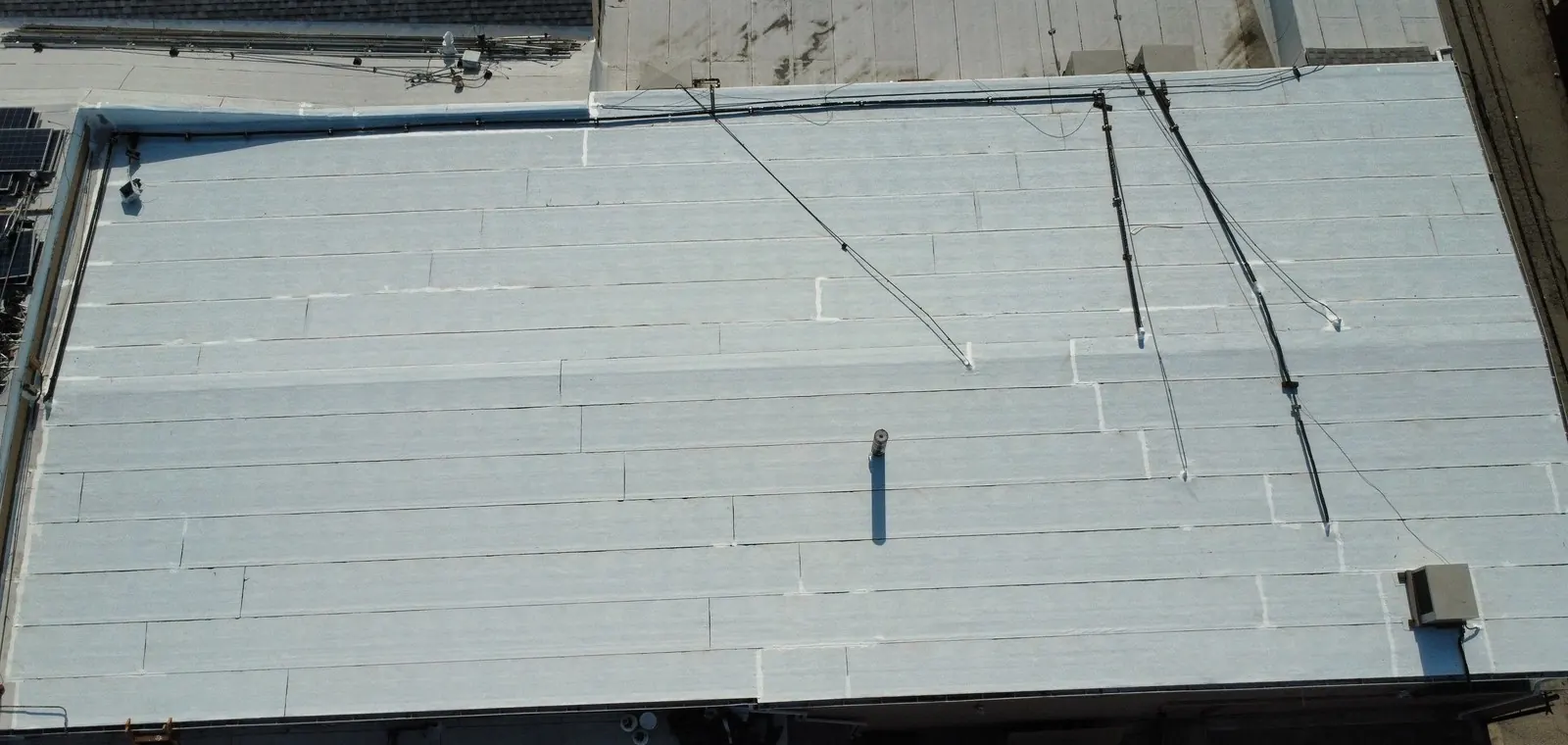
Water reaches the inside of a building through an open seam, a tired flashing or a blocked drain. It can then travel along the deck before it shows up as a stain. So the wet ceiling tile and the real entry point may sit far apart.
We work on low-slope roofs on houses and commercial buildings across Santa Clarita. Torch-down modified bitumen is our primary system for those roofs. Our crew starts at the roof surface and its drainage rather than at the stain inside.
Flat roofs still need a drainage plan
A flat roof is not truly level. Builders give it a slight pitch so water moves toward drains, gutters or scuppers. A scupper is the opening cut through a parapet wall at the roof edge.
When that path stops working, water sits on the membrane instead of leaving it. Our crew looks at where the surface holds water after rain and whether the drains run clear. We also check the edge details, the parapet caps and the low spots near penetrations.
Drainage is also the reason we ask about the building before we quote anything. A roof with two internal drains behaves differently from one that sheds to a single scupper. Those details shape the rest of our roofing work in Santa Clarita.
Standing water is a symptom worth checking, not a normal feature of a low-slope roof. It can point to a sagging deck, a blocked drain or a drainage layout that never worked well. We treat each roof on its own evidence instead of assuming one cause.
Leaks at seams, edges and penetrations
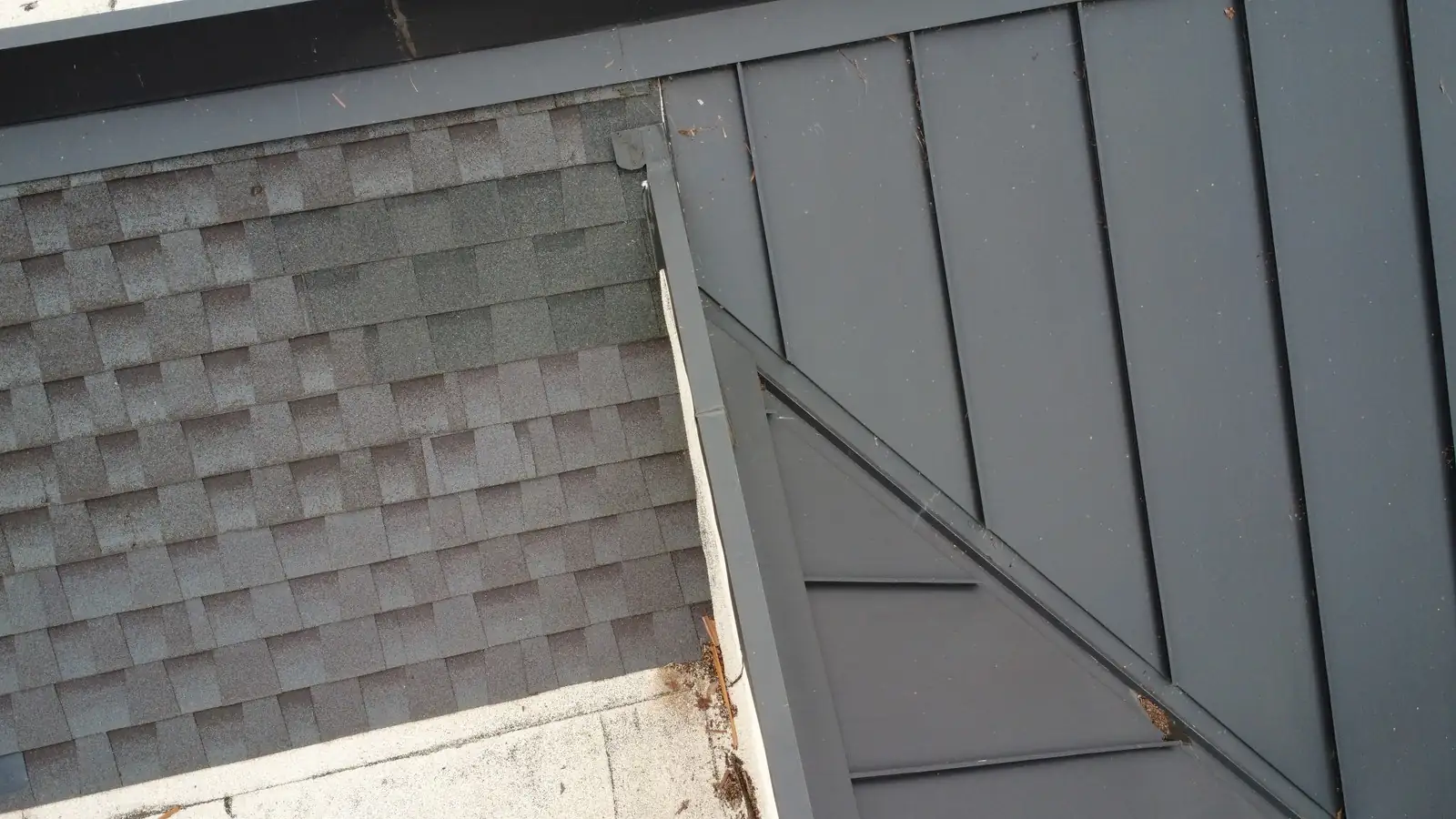
The open field of a flat roof is the simple part. The harder places are the laps between rolls, the flashing at a wall and the drain bowls. Each of those joints has to hold a seal where two separate pieces of material meet.
A stain inside tells us that water got in somewhere, and little more than that. Water can run along a slope in the deck or follow a conduit before it drops. So our crew reads the inside evidence, then checks the roof interfaces that could feed it.
Some of what we find is a contained fix, such as a failed lap or loose flashing. Other roofs show damage spread across the field, where a patch would only buy time. We tell you which one we are looking at before any roof repair begins.
Wind-driven rain and debris both play a part at the edges of a low-slope roof. Leaves and gravel gather at a drain, hold water back and keep the laps wet longer. Clearing that debris is ordinary upkeep and it protects the laps through the wet months.
Modified bitumen roofing
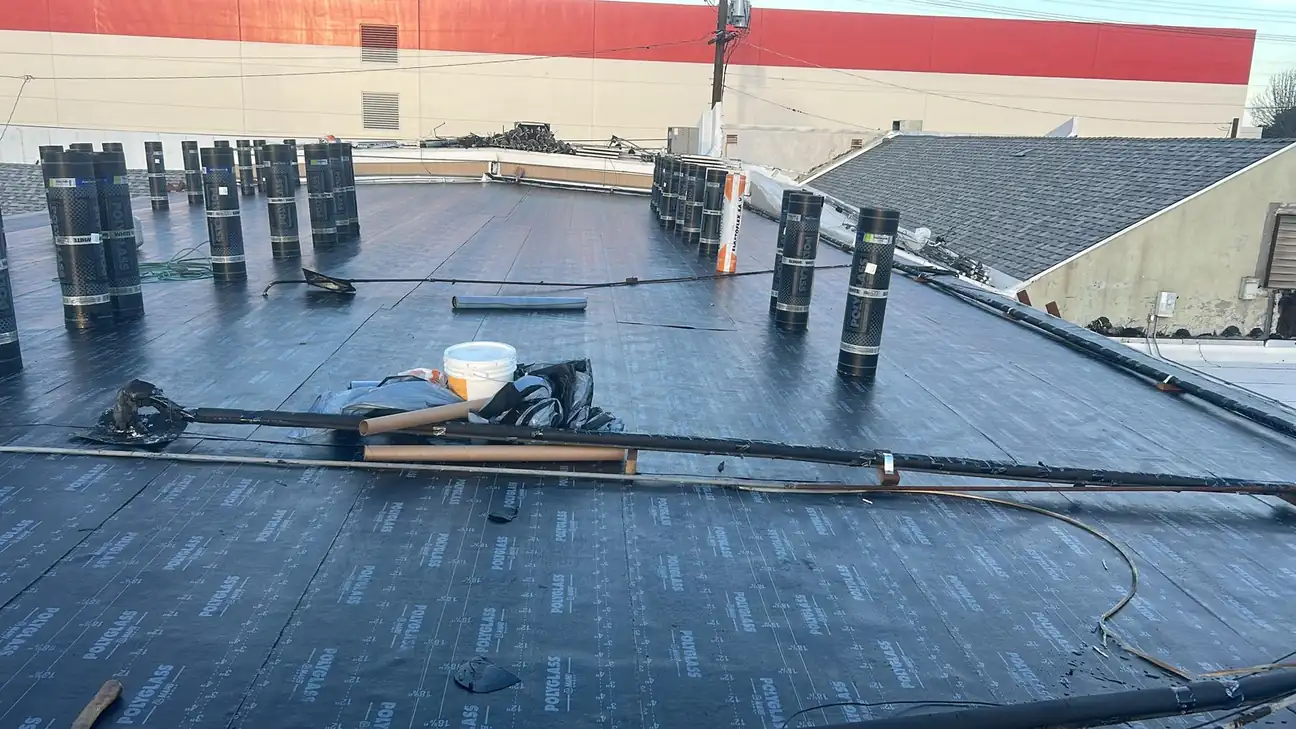
Modified bitumen is an asphalt-based membrane that comes in rolls with a reinforcing mat. Our crew unrolls it in overlapping courses and heat welds the laps so they fuse into one surface. Roofers call that torch-down work, and it is our primary low-slope system.
A cap sheet is the granulated top layer of the assembly. The one we prefer is Polyglass Polyfresko G, an APP granulated cap sheet for low-slope roofing. Polyglass documents the heat-welded method on the Polyfresko G product page.
Whether that system fits your roof depends on the substrate and the components it sits with. We check what is already on the deck before we specify anything. Some commercial buyers ask for TPO roofing instead, which we also install.
A modified bitumen assembly is more than the cap sheet. Base layers, the deck below and the edge metal all belong to the same system. When one of them is wet or damaged, a new surface will not fix it.
Repairing or replacing a low-slope roof
The decision rests on the membrane condition, the layers beneath it and the size of the damage. A sound roof with one failed area is a repair candidate. A roof with wet insulation, several old layers or a soft deck is a different conversation.
Replacement starts with a tear-off, which means stripping the old covering down to the deck. With the deck open, our crew can see the sheathing and replace boards that have rotted. That is where a hidden problem becomes a change order, so we say so up front.
A full roof replacement carries our ten-year workmanship warranty on the work we perform. That warranty applies to full replacement rather than to a patch or a partial repair. Estimating either one is free, and we can look at a low-slope roof without charge.
A written inspection report is a separate paid service for escrow paperwork or an insurer request. We prepare that report when you ask for it, and the fee depends on the roof. A free estimate stays the normal first step for repair or replacement pricing.
We help property owners pull a required roofing permit through the City of Santa Clarita Permit Center. Whether a specific project needs one depends on the scope, and the city decides that. Call (661) 367-8211 and we can start with a look at the roof.
Access and rooftop equipment coordination
Access is the first practical question on a low-slope building. We ask how our crew reaches the roof and where a truck can stage material. On an occupied building, we ask who needs notice before work starts overhead.
Condenser units, curbs, conduit, vents and solar arrays can sit on a low-slope roof. Installers fasten some through the membrane and weigh others down with ballast. Our crew flashes the penetrations we find so each opening stays sealed.
Equipment that has to move belongs to its own trade. If panels or a condenser must come off, we plan the roofing around the company that services them. Our part is the roof deck, the membrane and the flashing that seals each curb.
We walk through that sequence with whoever manages the building. Larger buildings and multi-unit properties follow the same logic on our commercial roofing work. The roof still decides the method, and the schedule works around what is on it.
Flat roofing questions we hear
What is torch-down roofing?+
Torch-down is the trade name for a modified bitumen membrane applied with heat. Our crew rolls out the sheets and welds the laps so the seams fuse together. It is our primary system for low-slope roofs.
Does a flat roof still need drainage?+
Yes. Builders give a flat roof a slight pitch that moves water to drains, gutters or scuppers. Water that sits after a storm is a sign to check the drains, the slope and the deck.
Can a low-slope roof be repaired?+
That depends on the roof. Where the failure is contained and the layers underneath are dry, a repair can make sense. Where the membrane has failed across the field or the deck is soft, we will say so.
Tell us what the roof is doing and where the water shows up inside. Call (661) 367-8211 for a free estimate, or send those details through our contact page.
Santa Clarita Roofing Contractors is a division of Home Vision Remodel. We work under CSLB #1112525 on low-slope roofs for homes and commercial buildings.